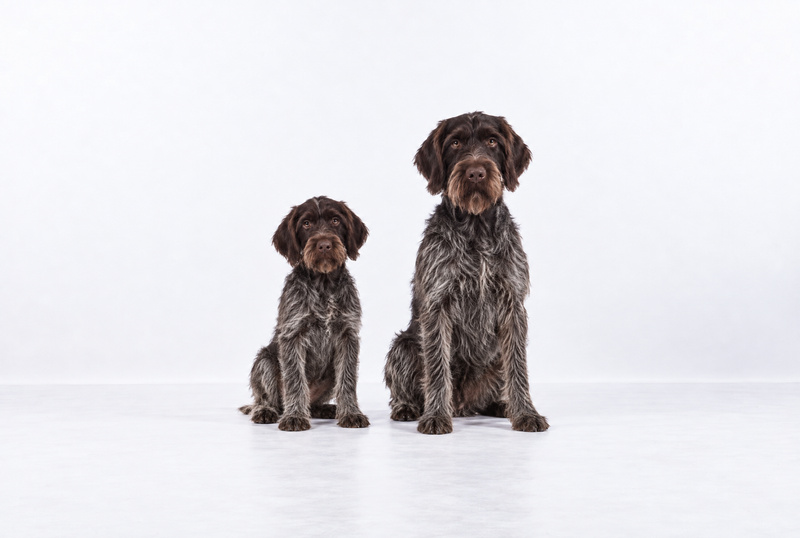
The Drahthaar at a glance
At 57 to 68 cm at the withers depending on sex, the Drahthaar commands attention with a robust silhouette under a hard, “wire”, flat, dense coat, backed by a waterproof undercoat that effectively protects him from brambles and bad weather. Recognised by the FCI under standard No. 98, in the section of continental pointing dogs of the pointer type, the official standard describes him as firm, self-controlled, balanced, fearless of game, neither timid nor aggressive[1].
Origin and history
The Drahthaar appeared in Germany at the end of the 19th century, from crosses between several wire-coated breeds — the Stichelhaar, the Pudelpointer, the Griffon — and the German Shorthaired Pointer (Deutsch-Kurzhaar), with the aim of obtaining a dog both protected on difficult terrain and fully versatile in the field. Sigismund Freiherr von Zedlitz und Neukirch is the central figure of this selection: he set the founding principle that still structures the breed today, “performance before the standard”, giving absolute priority to working ability over appearance[2].
The Verein Deutsch-Drahthaar (VDD), the breed club founded in May 1902, has imposed from the outset compulsory working trials and a physical examination for any dog intended for breeding — a requirement that still sets the breed apart, in Europe, from other wire-coated lines sometimes known by similar names but selected without this rigour[2].
Character and needs
The Drahthaar combines remarkable hunting abilities with the temperament of a family companion, provided his needs are met. Affectionate and loyal with his own people, he keeps an independent hunter’s instinct inherited from his selection.
- Physical exercise Very high: at minimum an hour of intense activity a day, ideally topped up with real hunting work or dog sport.
- Working instinct Marked: he is a dog that needs a mission, or he develops unwanted behaviour.
- Sociability To be worked on early: early socialisation is essential, as the breed can be reserved or even wary with strangers and other dogs.
- Coat care Moderate: the wire coat naturally resists dirt, but regular grooming (hand-stripping or “trimming”) is recommended.
A working dog above all, with an extraordinary hunting instinct and endurance, the Drahthaar can range over long distances in the heat of the hunt: a GPS tracker for dogs lets you follow him from a distance.
Escape instinct
Always know where he is. Live, the moment you look for him.
GPS + Galileo accurate to 5 m, a virtual fence with alerts, Europe-wide coverage. The tracker is 49 €, plus the subscription, from 13,99 €/month.
Discover the tracker
Health
The Drahthaar has a life expectancy of 12 to 14 years, often above the average for dogs of his size, but several points to watch are worth knowing about.
Hip and elbow dysplasia
A joint malformation fairly common in large active breeds; X-ray screening of breeding dogs, already required by the VDD as part of its compulsory trials, limits its transmission.
Gastric dilatation-volvulus
A life-threatening emergency linked to his deep chest. Splitting meals and avoiding intense exercise just before or after eating reduces this risk.
Epilepsy and von Willebrand disease
Genetic epilepsy and a clotting disorder (von Willebrand disease) are documented in the breed, requiring specific veterinary follow-up when diagnosed.
Ear infections and retinal dysplasia
His drooping ears encourage ear infections, while retinal dysplasia is also reported in some dogs; regular eye screening remains recommended.
This information is given for guidance only and does not replace the advice of a vet, the only person qualified to examine and monitor your dog.
Training
Intelligent and eager to work, the Drahthaar can also be stubborn, which calls for firm, consistent training from an experienced owner. It is generally not a breed recommended for a first dog.
Two priorities to keep in mind:
- An early, rigorous socialisation, in particular towards strangers and other dogs, to prevent any excessive wariness.
- Real work to give him — hunting, tracking, dog sport — without which his energy and instinct turn to troublesome behaviour.
Budget and price
Prices vary from one breeder to another, so there is no single benchmark figure. Look first for a breeder whose breeding dogs have passed the compulsory working trials of the breed club, the VDD. In Ireland, a puppy cannot be sold before 8 weeks and any advert must show his microchip number.
Beyond the purchase, plan an ongoing budget for food, veterinary care and ideally health insurance, as the breed is exposed to orthopaedic and digestive conditions that can lead to significant costs.
Is the Drahthaar right for you?
This dog suits an experienced owner, a hunter or a very sporty person, able to give him real daily work and firm training from a very young age.
He does not suit a sedentary household, a novice owner, nor anyone looking for a sociable dog without prior socialisation effort. Before you commit, find out about the steps for adopting a dog responsibly.