The Bernese Mountain Dog at a glance
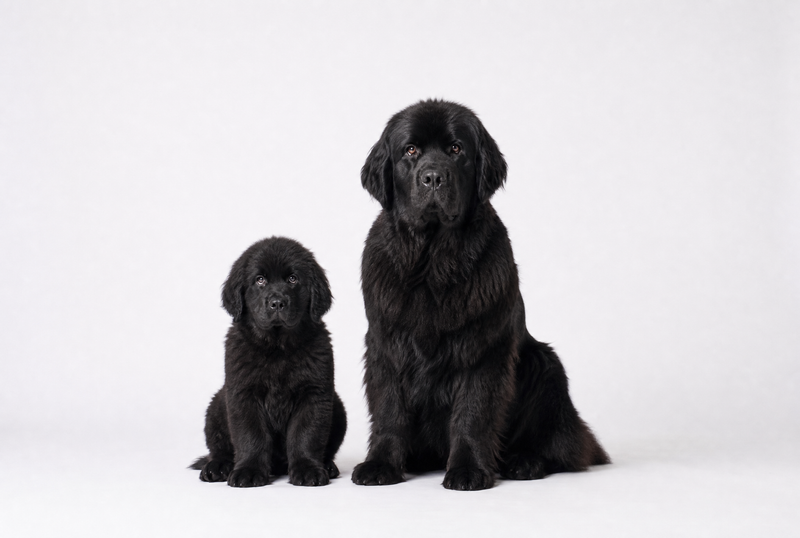
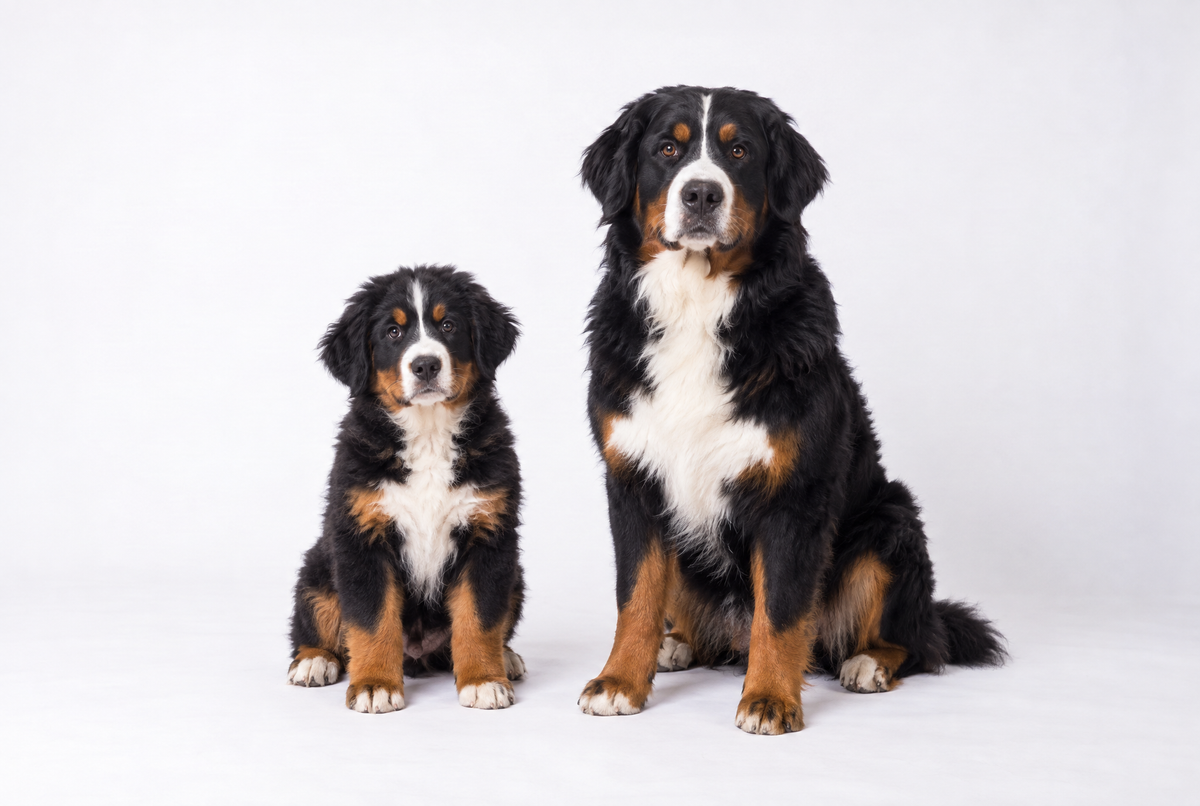
Recognised by the FCI under standard No. 45 (last revised on 5 May 2003), the Bernese Mountain Dog belongs to the group of molossoid breeds, mountain dogs and Swiss cattle dogs — but unlike the Newfoundland or the St Bernard, which are classed in the “mountain type” section, he falls under a separate section devoted to the four Swiss cattle dog breeds (section 3)[1]. His characteristic tricolour coat — black base, white cross-shaped chest marking, tan points — and his thick, long hair make him one of the most recognisable mountain dogs.
Origin and history
The ancestors of the Bernese Mountain Dog were farm dogs from the Bernese plateau, the Emmental and the Swiss Pre-Alps, used for generations to guard farms and pull small carts of milk to the cheese dairies — a role that earned him the nickname “poor man’s horse”. They were then known as “Dürrbächler”, after the hamlet of Dürrbach, where this type of dog was particularly common.
The breed emerged from obscurity in 1902, when four dogs were shown for the first time at a dog show; the decisive step came in 1904, at the international show in Bern, where six “Dürrbächler” were entered and four of them won prizes. Fritz Probst (1867-1945) became its main promoter, with the support of the Berna cynological society, encouraging more systematic breeding. In 1907, breeders from Burgdorf founded the Swiss Dürrbächler Club and drew up the breed’s first standard. In 1908, Professor Albert Heim proposed renaming the breed “Bernese Mountain Dog” to bring its name into line with the other Swiss cattle dog breeds; despite initial resistance from the Burgdorf breeders, the name was officially adopted in 1913[2].
Character and needs
The Bernese Mountain Dog is calm, affectionate and extremely attached to his own people — often called a “velcro dog” because he so constantly seeks contact with his family. Reserved, even wary of strangers at first, he generally relaxes once introductions are over, and barks little, but with conviction when he senses something suspicious.
- Physical exercise Moderate: not sporty by nature, he nevertheless needs fairly long daily walks to stay in shape.
- Space Considerable: his large size makes a house with a garden clearly preferable to a flat.
- Heat tolerance Low, because of his thick, long coat: shade and cool water are essential in summer.
- Coat care Substantial: he moults heavily and regular brushing, several times a week, is needed to limit tangles.
His strong need for human company makes him a poor fit for homes that are often empty during the day. Attached to his territory and his family, the Bernese Mountain Dog is better off wearing a dog GPS tracker, particularly on a property with a garden.
Escape instinct
Always know where he is. Live, the moment you look for him.
GPS + Galileo accurate to 5 m, a virtual fence with alerts, Europe-wide coverage. The tracker is 49 €, plus the subscription, from 13,99 €/month.
Discover the tracker
Health
The Bernese Mountain Dog’s life expectancy varies noticeably between studies and countries: a landmark Swiss study of 381 dogs born in 2001-2002 reports a median of 8.4 years, a 2013 Dutch study reports around 8 years, another 2013 study 8.1 years, while a more recent British study (2024) puts the average at 10.1 years — a gap that may reflect a recent positive trend or differences in methodology between studies. In every case, this is a breed whose longevity remains below the average for large dogs[3][4].
Cancer and malignant histiocytosis
Cancer is by far the breed’s leading cause of death: the Swiss study cited above puts it at 58.3% of observed deaths (222 dogs out of 381), a figure that confirms the order of magnitude — “nearly six dogs in ten” — found in several veterinary overviews of the breed[3]. Among these cancers, malignant histiocytosis (or histiocytic sarcoma), an aggressive and incurable form, holds a special place: it accounted for 23 of the 222 cancer deaths recorded in the Swiss study, or about 10% of confirmed tumours, while other overviews mention a proportion that may reach a quarter of the breed’s tumours depending on the populations studied — a gap that reflects different diagnostic methods and samples rather than a single, certain figure[3][4]. It most often appears in adulthood, between 3 and 8 years of age.
Hip and elbow dysplasia
Elbow dysplasia is well documented in the breed, with a reported prevalence of roughly 14% to 26% depending on the study. For the hips, an official X-ray screening scheme exists, but its results compare poorly from one country to another, each evaluation system having its own criteria[4][5]: ask the breeder for the parents’ results.
Degenerative myelopathy and other predispositions
A genetic mutation associated with degenerative myelopathy (SOD1 gene) is present in the breed, carried in the homozygous state by a minority of dogs according to the genetic tests available. A predisposition to kidney disease and mast cell tumours (skin tumours) is also documented in several studies[4].
This information is given for guidance and does not replace the advice of a vet, the only person qualified to examine and monitor your dog. Given how common cancer is in this breed, regular vet check-ups — palpation of the lymph nodes, routine tests — and suitable health insurance are particularly recommended.
Training
The Bernese Mountain Dog is a sensitive dog who responds well to positive, consistent training; his size, however, means some lessons need to be taught from a very young age, before he reaches his adult size.
Two priorities to keep in mind:
- Early socialisation, essential for a dog who is naturally reserved with strangers.
- Learning to walk on the lead from the first months, while the puppy is still easy to manage.
Budget and price
Prices vary widely from one breeder to another, and the cheapest puppies generally come with less thorough health follow-up and genetic testing: compare several breeders, see the puppy with his mother and ask for the parents’ screening results.
The recurring budget is substantial — food, coat care, vet care and health insurance — the last being all the more advisable as the breed has a strong predisposition to cancer.
Is the Bernese Mountain Dog right for you?
This dog suits a family with enough space, at home for a good part of the day, and ready to invest in coat care as well as attentive veterinary follow-up.
He does not suit a home that is often empty, a home with no outdoor space, or a very hot climate where his heat tolerance would be sorely tested. Before committing, find out about the steps involved in adopting a dog responsibly.