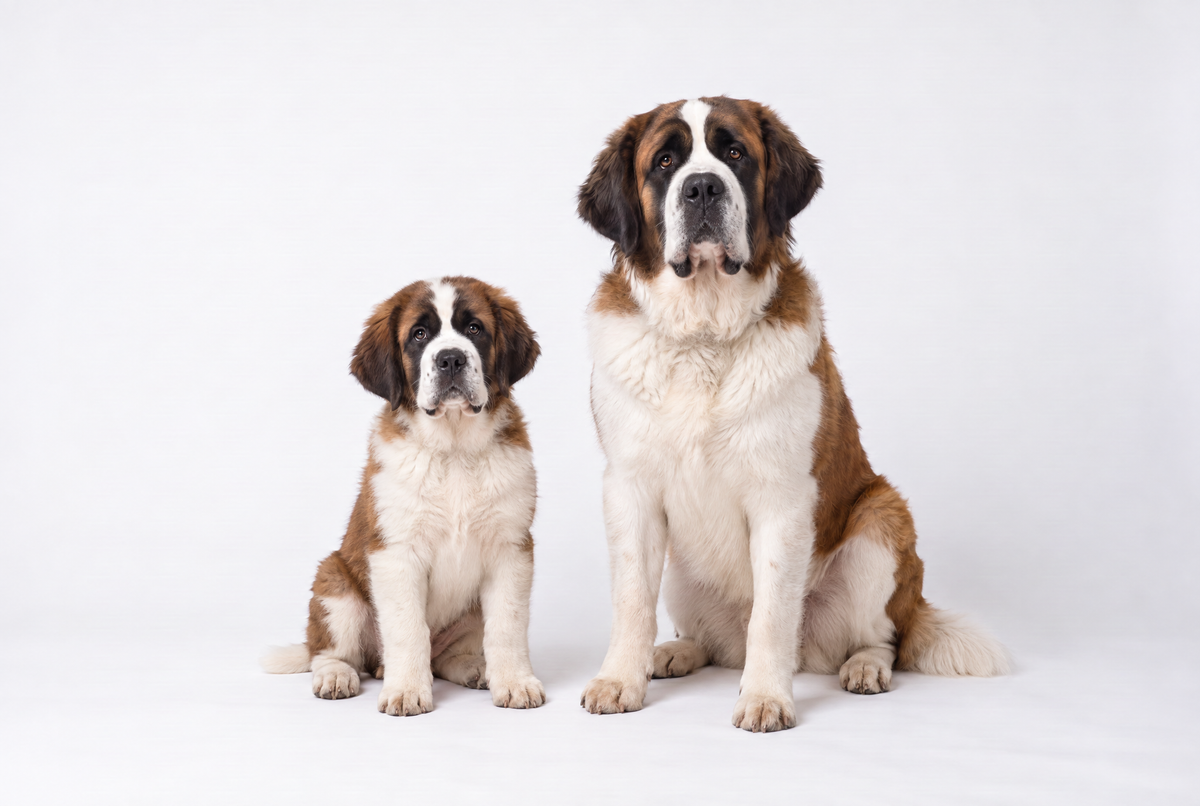
The St Bernard at a glance
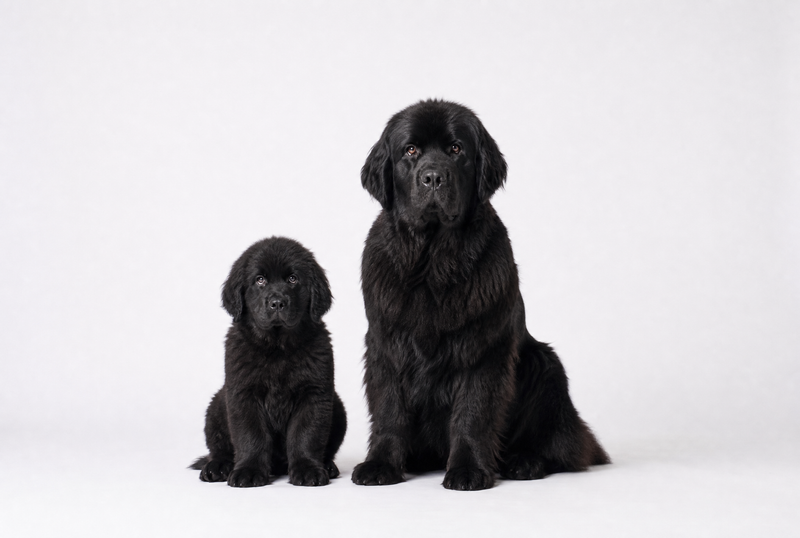
At 65 to 90 cm at the withers depending on sex and a weight that can exceed 100 kg in males, the St Bernard is among the largest recognised dog breeds. Recognised by the FCI under standard No. 61 (last revised on 3 June 2016), in the group of molossoid breeds, mountain-type section — the same as the Newfoundland — the breed exists in two varieties: short-haired and long-haired[1].
Origin and history
The St Bernard takes his name from the Great St Bernard Hospice, founded in the 11th century in the Pennine Alps to welcome travellers crossing this high mountain pass. Religious communities in the cantons of Vaud and Valais began donating dogs to the hospice around 1660-1670; their presence there is formally documented from 1709, when the prior Ballalu mentions the canons’ use of them. These large mountain-type dogs proved particularly effective at finding travellers who were lost or buried under snow.
The breed owes much of its fame to Barry, a dog born at the hospice in 1800 and active as a rescuer until 1812, credited with more than forty rescues during his career — a figure that has varied between sources over time. A persistent legend, engraved on a monument in Paris, claims he was killed by the 41st person he was trying to save; modern historical sources refute this dramatic version, Barry having in fact ended his life peacefully in Bern. The breed’s pedigree records began with Heinrich Schumacher in 1867, the Swiss stud book opened in 1884 with a dog named Léon as the first registered dog, and the breed was officially recognised as a Swiss national breed at an international canine congress in 1887. The long-haired variety was developed in the late 19th century by crossing with the Newfoundland[2].
Character and needs
The St Bernard is a placid, patient companion, very attached to his family and known for his gentleness despite his impressive size.
- Physical exercise Moderate: daily walks are enough, with no need for intense activity.
- Space Considerable: a house with a garden is far preferable given his adult size.
- Heat tolerance Low, because of his thick coat: shade and cool water are essential in summer.
- Upkeep Substantial: heavy drooling linked to his pendulous lips, and heavy moulting requiring regular brushing.
With a puppy of a few months already weighing several dozen kilos, early socialisation and early lead training are a must. A placid companion attached to his territory, the St Bernard has every reason to wear a GPS dog collar, particularly on a large property.
Escape instinct
Always know where he is. Live, the moment you look for him.
GPS + Galileo accurate to 5 m, a virtual fence with alerts, Europe-wide coverage. The tracker is 49 €, plus the subscription, from 13,99 €/month.
Discover the tracker
Health
The St Bernard’s life expectancy is generally between 8 and 10 years, a fairly short span linked to his very large size; some dogs live past 10, but this remains relatively rare for the breed.
Hip and elbow dysplasia
A major and well-documented predisposition in this very large breed. Systematic X-ray screening of breeding dogs remains essential.
Gastric dilatation-volvulus
A life-threatening emergency that is common in this deep-chested breed. Splitting meals and avoiding intense exercise around mealtimes reduces this risk.
Heart conditions and osteosarcoma
Dilated cardiomyopathy is documented in the breed, calling for regular heart vigilance. Like most giant breeds, the St Bernard also has a predisposition to osteosarcoma (bone cancer).
Entropion, ectropion and epilepsy
Eyelid abnormalities (entropion, ectropion) are documented in the breed, as are cases of idiopathic epilepsy. These conditions are attributed, at least in part, to historically intensive selection on morphological criteria; genetic research programmes aimed at improving the breed’s health are now under way.
This information is given for guidance and does not replace the advice of a vet, the only person qualified to examine and monitor your dog. Given the orthopaedic and heart issues specific to the breed, regular vet check-ups and health insurance are particularly recommended.
Training
The St Bernard responds well to a positive method, but his size means some lessons need to be taught from a very young age, before the puppy reaches a size that is hard to manage.
Two priorities to keep in mind:
- Early lead and recall training, from the first months rather than once the dog has grown up.
- Early socialisation, as for any large dog meant to live with a family.
Budget and price
Prices vary widely from one breeder to another: compare several, see the puppy with his mother and ask for the parents’ hip and elbow screening results.
The recurring budget is substantial — heavy feeding given his size, vet care, health insurance — a dog of this size generating costs markedly higher than a medium-sized breed.
Is the St Bernard right for you?
This dog suits a family with enough space, who accept his drooling and moulting and are looking for a placid, protective companion; supervision is still recommended with very young children given the dog’s size.
He does not suit a city home with no outdoor space, or a very hot climate where his heat tolerance would be sorely tested. Before committing, find out about the steps involved in adopting a dog responsibly.